
Amazon Workers Spoke In Favor Of Seattle's Data Center Moratorium, Now They Claim Their Bosses Are Retaliating

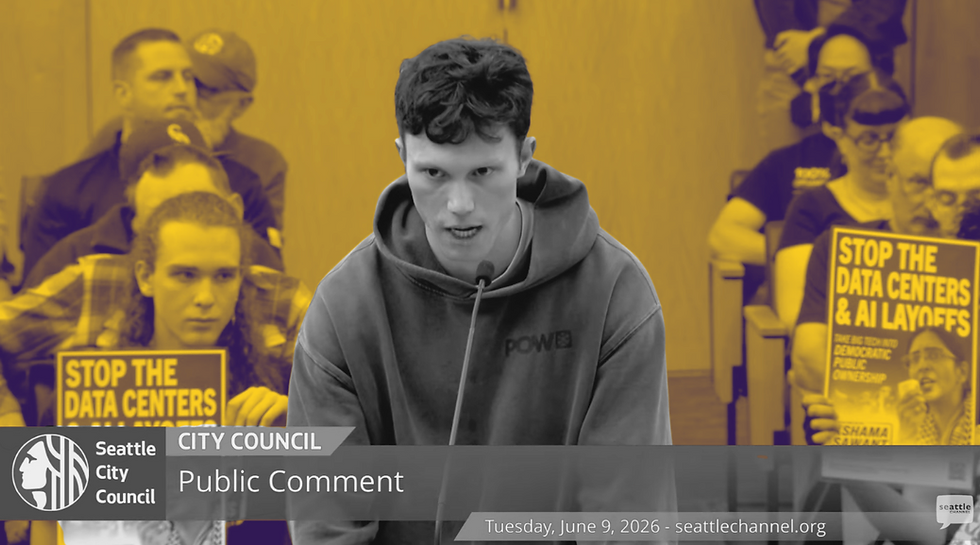
“I am grateful to live in a City where employees that speak out politically are legally protected against retaliation.”
That’s how several Amazon workers associated with Amazon Employees for Climate Justice (AECJ) began their public testimony at Seattle City Hall in favor of the City’s first-of-its-kind one-year moratorium on new data centers earlier this month. It’s almost as though they knew their employer would punish them for speaking out against unregulated AI and hyperscale data centers because days later, Amazon pulled three software engineers into a meeting with Employee Relations where they learned the company had put them under disciplinary investigation for their public comments. According to a press release sent last Thursday, AECJ filed a complaint with the City, alleging Amazon broke its law against retaliation.
On June 9, Seattle became the first City to temporarily ban the construction of large, new data centers in response to a powerful, local movement calling for regulations after the Seattle Times exposed that unidentified companies recently inquired about building several new hyperscale facilities within City limits. That day, public commenters gushed in support of the legislation, including several tech workers associated with AECJ.
The next day, Amazon Employee Relations called software engineers Patrick Schloesser, Darius Irani, and Liesl Wigand in for a meeting about their comments at a previous hearing related to the historic moratorium earlier this month.
In a recent press release, Schloesser, Irani, and Wigand said they believe Amazon intended to intimidate them. Irani described the meeting as a “really threatening” private interrogation.
“[Amazon] ask[ed] me the same questions over and over to try to get me to admit to doing something wrong and made me feel like I committed a crime,” said Irani. “All I did was testify because I believe it’s critical that the government regulates data centers and AI. Workers need to be involved in these conversations.”
But the workers' fear is overridden by their conviction.
“[The meeting] was very scary and disorienting, but I decided to participate in reporting this to the City because I’m tired of feeling afraid,” said Schloesser. “If we allow corporations to infiltrate our politics and our politicians’ pockets as well as control our speech, then we are lost. Our right to speak out based on our political beliefs is a fundamental right and corporations attempting to threaten that right is an attack on our democracy.”
This appears to be one discrete incident in a broader pattern of big tech “casting aside” democracy to enable the rapid, unfettered expansion of data centers as AECJ described in their press release. And workers in Seattle are uniquely positioned to stand up to the big tech bosses thanks to the City’s particularly strong protections for workers against this type of retaliation. AECJ’s legal counsel Abby Lawlor argued that this unique protection “prohibits exactly what Amazon is doing now—investigating them and threatening their employment as a direct consequence of their advocacy.”
Amazon disagrees that it broke the law by launching these investigations. To the company, this isn’t a case of retaliation for speech, it is a case of evenly applying their policies.
“While our teammates are always free to talk about their working environment, we have policies against speaking as a representative of the company without following certain procedures — all of which are clearly agreed to by everyone who works at Amazon, and are similar to policies at many other companies,” Amazon spokesperson Margaret Callahan “As we looked more closely at how these employees represented themselves, and how their comments were received by others, it became clear that they may have been speaking in their capacity as Amazonians and not as private citizens. We believe it’s important to apply our policies consistently so, just as we would with anyone else, we’re investigating whether there was a violation of our policies and may or may not take action based on what we find. It's important to note that we don't tolerate retaliatory behavior. It's also inaccurate to say that we have plans to terminate these employees or told them they were at risk of termination."
Still, the workers have allies in at least Council Members Eddie Lin and Alexis Mercedes Rinck, who both released public statements about the incident.
"No worker should ever face this kind of intimidation from their employer for exercising their lawful First Amendment rights and speaking on their beliefs, yet these actions come as no surprise,” Rinck said. “Communities nationwide are demanding answers on what the long-term impacts of data centers will be. And in response we are seeing these kinds of retaliatory and bullying tactics designed to scare people into silence. This is unacceptable”
Mayor Katie Wilson did not respond to The Burner’s request for comment, but I will update if she does.
She’s been a little shy about labor advocacy after her calls to boycott Starbucks became national news and the right wing blamed her for Starbucks leasing corporate office space in Tennessee. Taking a strong opinion on this before the City formally investigates AECJ’s complaint may be premature and may put her at odds with Amazon, which, like Starbucks, sometimes puts money toward private-public partnerships. But supporting these workers could help her rebuild some credibility with her lefty base, of which she is in critical need.


Comments