
Here Are The Anti-War Emails That Allegedly Got UW Professor Removed From Director Position


The University of Washington removed Dr. Aria Fani from his position as the director of the university’s Middle East Center (MEC). While UW admin won’t publicly admit it, Fani believes he was removed because he offered critical analysis of the ongoing US-Israel attacks on Iran, analysis based on the research and expertise the university literally hired him to share with their students. The incident is just one of many cases of universities suppressing criticism of Israel, its genocide in Gaza, and now its aggression on Iran.
“I feel profoundly hurt and betrayed,” Fani told The Seattle Times. “There’s a chilling effect on, not just my academic freedom, but that of my colleagues, anyone who dares to speak out against the war and against aggression.”
Last month, associate professor Fani sent two mass emails about the ongoing US-Israeli war on Iran through the MEC’s Listserv, which The Daily UW described as an opt-in newsletter. Fani made it immediately clear that the email expressed his personal views and “do not reflect the diversity of opinion” that exists within the Middle East Center or the Jackson School of International Studies (JSIS)
There's been a lot of discussion and national coverage on the two emails sent March 9 and March 18. But so far, it does not appear many (if any) other news outlets have published the emails in full. So here they are:
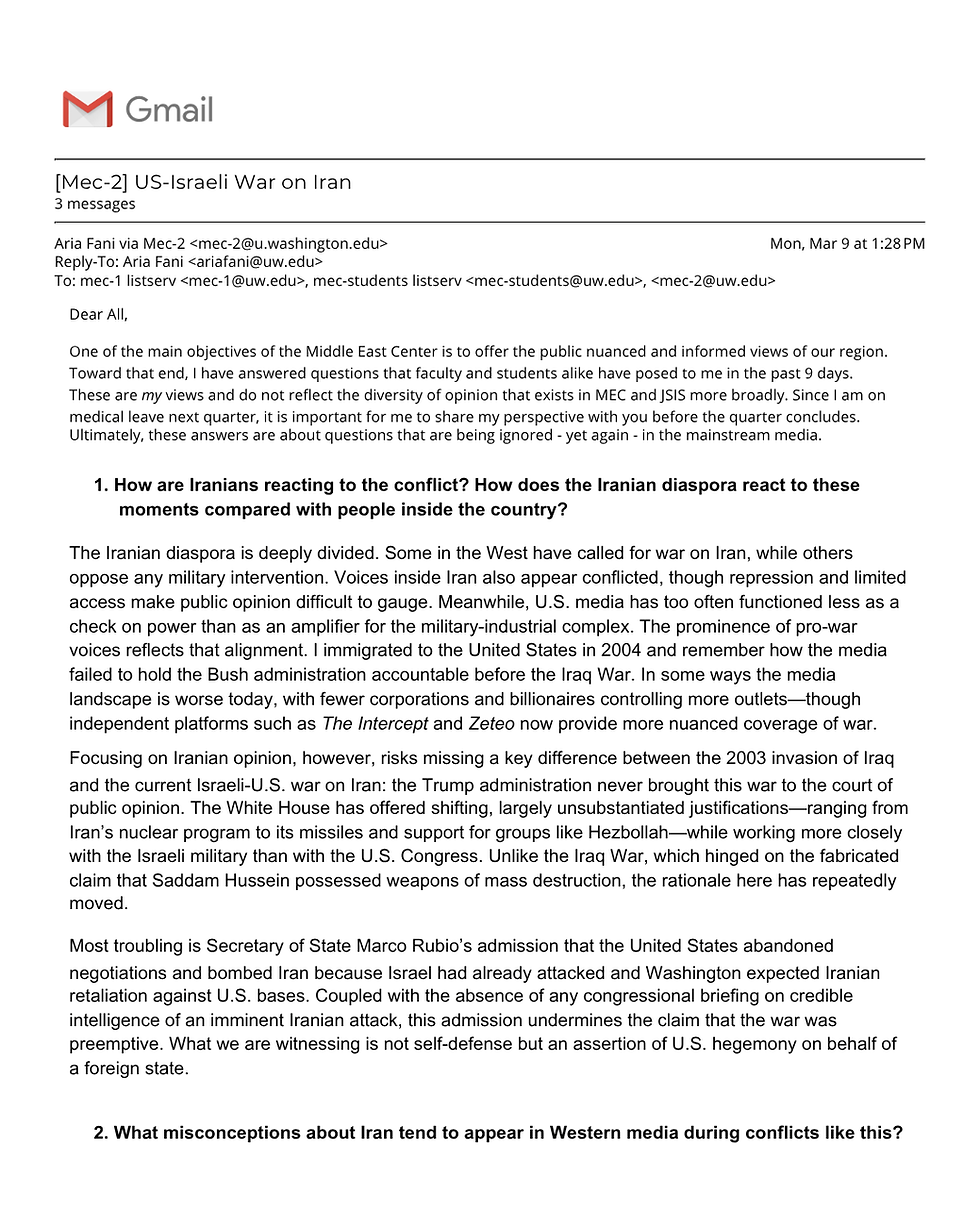


His second email, send March 18, seemed to ruffle more feathers:


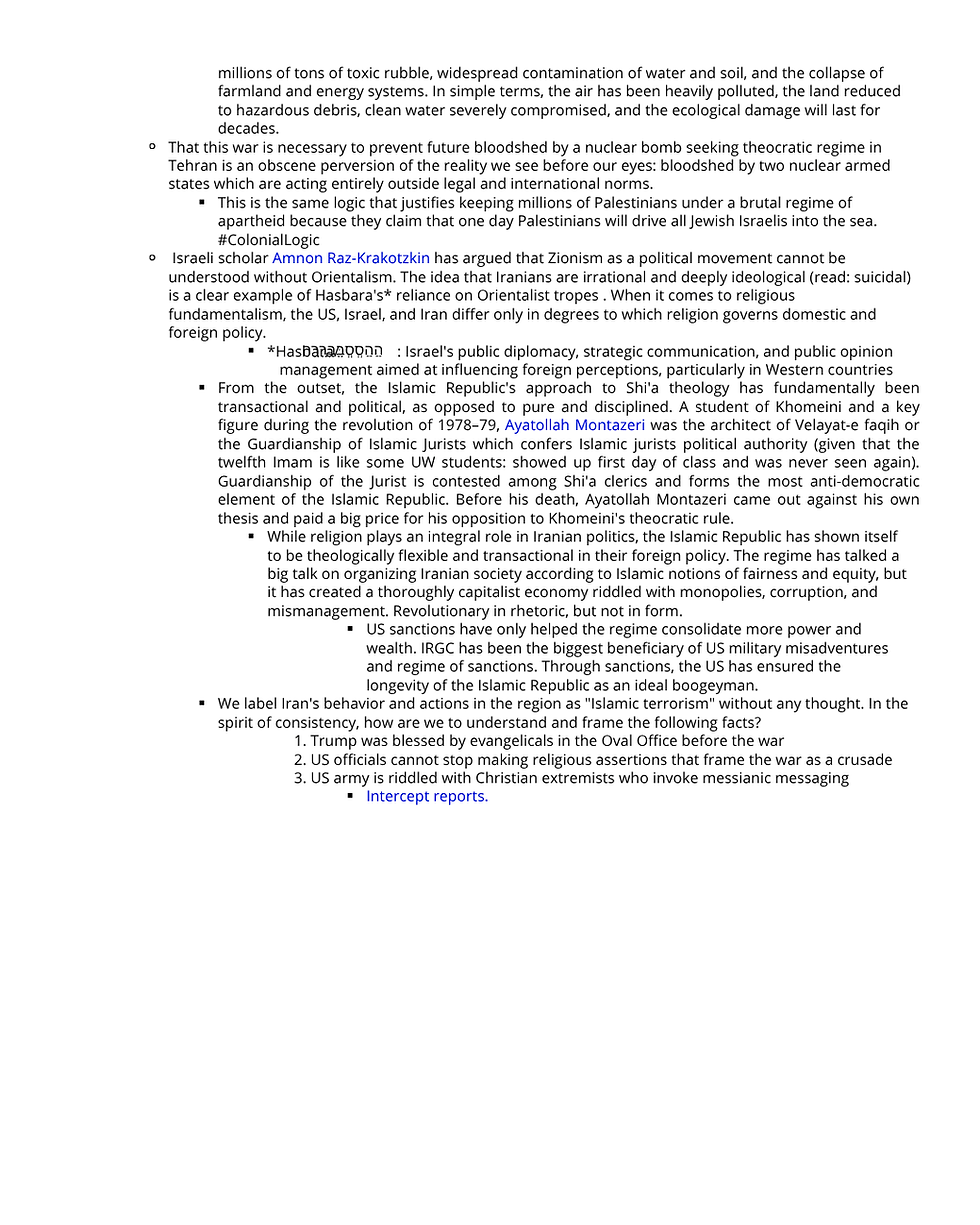


Fani came under fire from conservatives for disputing claims that Iran posed a nuclear threat: “That the Islamic Republic was either pursuing a nuclear bomb or that they were perpetually two weeks away from a bomb (Iranians do procrastinate after all) was always BS,” Fani wrote.
Conservatives seized on Fani’s dismissal, but that view is hardly a fringe, lefty conspiracy theory. Benjamin Netanyahu has spent decades claiming Iran was on the verge of a bomb, but U.S. intelligence officials, nuclear watchdogs, and arms control experts have repeatedly cast doubt on those apocalyptic timelines. Fani may have written the point flippantly, but he was not inventing it.
The Seattle Times also zeroed in on his comments about Israel and Zionism in the second email. Fani described Zionism as “cancerous, a potentially fatal outgrowth in our planetary body.”
Shortly after Fani sent the second email, he noticed the listserv was placed under moderation and he could no longer send emails. Then, on March 27, Fani received a short and “cryptic” call from JSIS director Daniel Hoffman, who booted him from his director role. Fani is still employed as an associate professor.
Fani told The Daily UW he feels his termination reflects a larger attack on free speech in academia.
Right-wingers used to eat this narrative up when they made martyrs out of conservative professors, protested over anti-trans beliefs or reprimanded for parody land acknowledgments. But they don’t seem to have the same fervor for free speech since students and professors started reporting suppression for their pro-Palestine, anti-Zionist views post Oct. 7. Palestine Legal, which challenges “efforts to threaten, harass and legally bully activists into silence and inaction,” reported a 600% increase in requests for legal support between 2022 and 2024. And academia was the backdrop for many — about two-thirds of reports to Palestine Legal were “campus-related.”
UW did not confirm Fani’s removal related to his criticism of Israel, Zionism, or the U.S. war machine.
“Out of respect for employee privacy and confidentiality, the university chooses not to discuss the circumstances surrounding individual employment outcomes. Employment decisions are based on the requirements of the position and university expectations,” UW said in a statement.


What interests me about exploring stories through creative reading is how a broad idea becomes part of an ordinary day. A character's journey can become a starting point for imagining a different place or perspective. I would use that point as a starting question when considering creative reading activities. The part I would like to explore further is what happens when the idea meets a real situation with its own limitations. How would you encourage readers to connect a story with their own questions?
The topic of learning from subject specialists gives me a few things to think about, especially when the discussion moves beyond general advice. A specialist's example can show how a broad principle applies to a particular problem. That is the kind of detail I would keep in mind while exploring expert learning guidance. The part I would like to explore further is what happens when the idea meets a real situation with its own limitations. What makes an expert explanation useful to someone with little background knowledge?
Thinking about exploring the relationship between nature and wellbeing, I find the smaller practical questions more interesting than a quick conclusion. Noticing a familiar outdoor place can offer a simple starting point for thinking about our surroundings. It also gives the phrase ecopsychology and wellbeing a clearer meaning than a label on its own. I would probably come back to this question after trying to work through one concrete example rather than deciding immediately. How could a nature activity leave space for different personal responses?
The subject of getting started with GIMP image editing feels more interesting when there is room for a reader to stop and ask their own questions. Working on a copy makes it easier to experiment with an image without losing the original. For me, that is a useful way into the broader subject of GIMP image editing. I can imagine different answers depending on the situation, so I would want to understand the context before drawing conclusions. Which editing tools should a beginner learn before trying more elaborate effects?
I find using the local environment in Zalesie lessons easier to think about when there is a concrete question to start from. A short walk can provide material for science, writing and observation in the same lesson. Seen this way, Zalesie outdoor learning becomes a topic to explore rather than something to sum up too quickly. A short discussion of an everyday example would make this easier for me to connect with, especially as someone still learning about the subject. How can an outdoor activity stay focused without losing its sense of discovery?